
Why Most Businesses Fail at Automation — And How to Fix It in 2026
Automation doesn't fail because of technology — it fails because businesses automate activity instead of understanding work. Here's the operations playbook that separates businesses that scale from those that stall.
Armaan Solanki
Operations Strategist, VyaptIX Technologies

Why Automation Keeps Failing
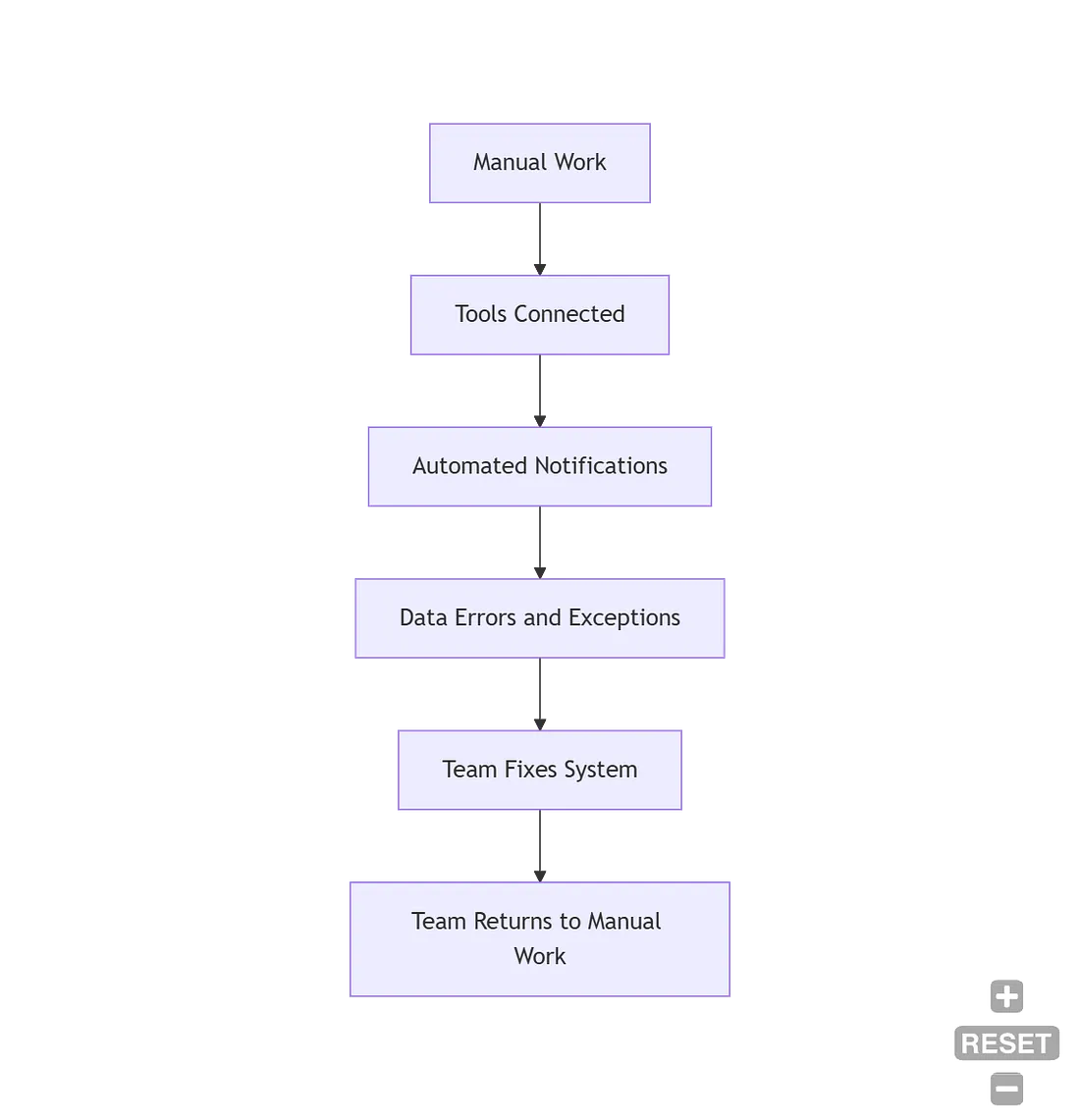
Every year, companies adopt AI tools, chatbots, workflows, and integrations with one expectation: connect everything once and save hours daily. Weeks later, teams still work manually. Customers still wait for replies. Reports still need preparation by hand. And the 'automation system' becomes another responsibility to manage. The tools aren't weak -- automation simply exposes operational confusion.
Automation doesn't fail because of technology. It fails because businesses automate activity instead of understanding work. Automation applied to an unclear process doesn't create efficiency -- it creates faster confusion.
In 2026, the businesses that win won't be the ones using the most automation tools. They'll be the ones using automation at the right stage of operational maturity. This distinction is everything -- and most businesses get it backwards.
What Actually Happens When You Automate the Wrong Way
Software demos show perfect workflows: structured dashboards, predictable triggers, clean outcomes. Real businesses operate differently. Employees follow varied methods. Customers ask unexpected questions. Exceptions happen daily. Most decisions live only in experience -- never in documentation. Automation doesn't remove this chaos. It follows it precisely. Work doesn't disappear -- it shifts into maintaining automations: fixing triggers, correcting data, supervising systems that were supposed to run themselves. The automation worked exactly as designed. The process was never defined.
| What Businesses Expect | What Actually Happens |
|---|---|
| Automation removes manual work | Manual work shifts to maintaining the automation itself |
| Systems run themselves end-to-end | Teams spend time fixing triggers and correcting bad data |
| Staff freed for strategic work | Staff return to manual tasks because the system feels unreliable |
| Efficiency scales with more tools | Confusion scales -- the underlying process was never defined |
Automation multiplies process quality -- in both directions. Unclear workflow → consistent mistakes at scale. Structured workflow → consistent growth at scale. Automation is not intelligence. It is amplification.
Three Conditions Automation Requires
Most companies automate in the wrong order: purchase tool → connect everything → expect efficiency. The result is wrong notifications, duplicate records, and staff reverting to manual work because the system feels unreliable. Automation only works when three conditions exist simultaneously -- and skipping any one of them guarantees failure.
Clear Process
Every step is documented -- not the ideal version, but the real version of how work actually happens inside your business today. The gap between these two is where most automation breaks.
Defined Responsibility
Every step has a named owner. Without clear ownership, automated tasks fall into a void where everyone assumes someone else is watching -- and nothing gets done.
Consistent Input Data
Manual operations tolerate variation. Automation depends on precision. Inconsistent data is the single fastest way to silently corrupt an automated workflow.
What Automation Should — and Shouldn't — Do
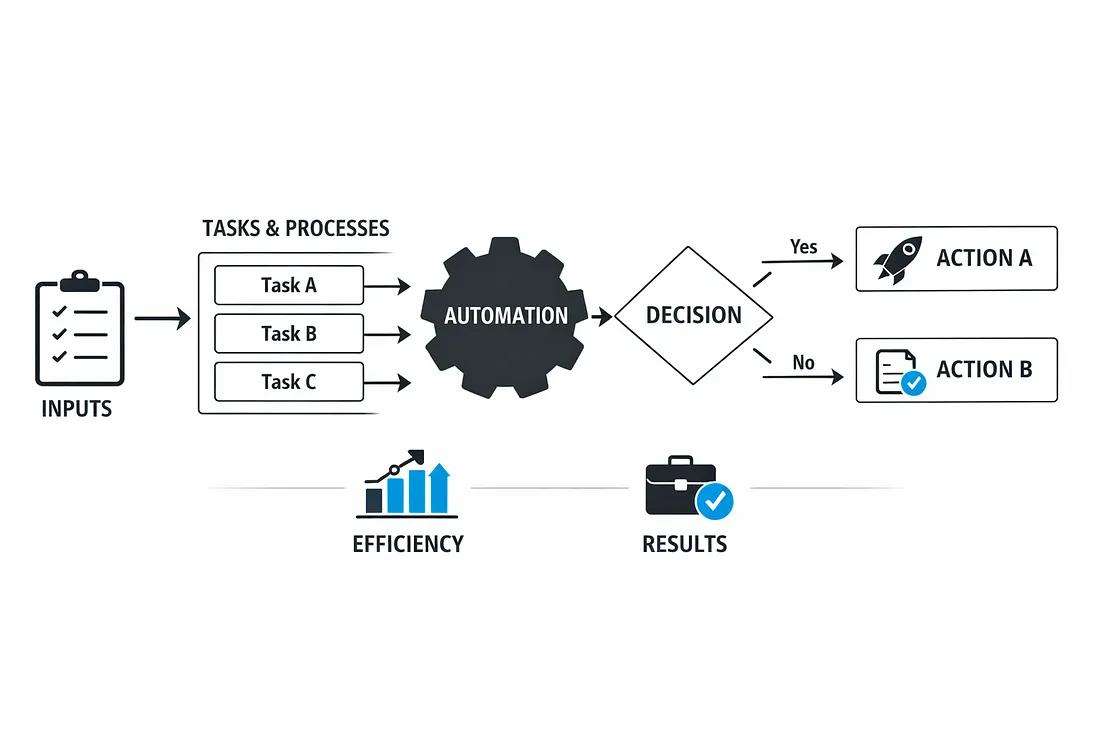
Automation is not designed to remove people from work. It removes repetitive decisions from people. This distinction matters enormously -- because businesses that treat automation as a headcount reduction exercise consistently fail, while businesses that treat it as a decision-removal exercise consistently succeed.
Good automation handles
Predictable steps, prevention of human forgetfulness, and standardized outcomes -- the things that happen the same way every single time.
Bad automation attempts
Judgment calls, exception handling, and situational thinking -- things that require experience, context, and human discretion to get right.
The real goal
Not fewer employees -- fewer routine decisions per employee. So your team spends their time on work that actually requires a human mind.
When done correctly
Automation increases clarity before it increases speed. Teams feel more in control -- not less -- after implementation.
How to Implement Automation Correctly in 2026
The correct way to implement automation in 2026 starts with observation -- not software. Most businesses jump straight to tool selection. The ones that succeed start by watching how work actually moves through their organization before touching a single integration.
- 1
Track one repetitive daily activity
Pick the single most predictable task -- lead follow-ups, status updates, appointment reminders -- and document every step as it actually happens, not as it should happen.
- 2
Document the real workflow, not the ideal one
The ideal process lives in presentations. The real process lives in team behavior. Automate the real one -- you can optimize later once it runs reliably.
- 3
Remove unnecessary decisions first
Before automating, strip out every step that only exists because 'that's how we've always done it.' Automating waste makes waste faster and more consistent.
- 4
Automate only the stable steps
Start with steps that never change. Leave judgment-heavy or exception-prone steps for humans until the stable steps are running perfectly.
- 5
Measure results before expanding
Quantify time saved, errors reduced, and team satisfaction. Automation grows in layers -- earn the right to add the next layer by proving the first one works.
What Businesses Get Right
The businesses seeing real results from automation in 2026 didn't automate everything at once. They automated the single most predictable process first -- and built deliberately from there.
| Business Type | First Process Automated | Outcome |
|---|---|---|
| Service company | Inquiry acknowledgement and routing | Response time dropped to minutes -- customer satisfaction immediately improved |
| E-commerce store | Order status updates to customers | Support ticket volume fell -- staff freed from repetitive update requests |
| Agency | Lead follow-up sequences | Lost leads re-engaged and converted -- revenue that would have disappeared |
| Clinic | Appointment reminders | No-show rate dropped sharply -- staff freed from making manual reminder calls |

None of these businesses automated their entire operation at once -- and that restraint is exactly what made their automation successful. The pattern is consistent: start small, prove the result, then expand with confidence.
Common Mistakes to Avoid
Automating everything at once
Widespread automation before process clarity guarantees widespread, consistent errors -- delivered at scale and speed you can't manually undo.
Choosing tools before workflows
Tools should be selected to serve a defined workflow -- not the other way around. Tool-first decisions force your process to contort around the software.
Ignoring operational staff
The people doing the work know where the real friction is. Skipping their input is the fastest way to automate the wrong things confidently.
Measuring features, not outcomes
The only metric that matters is time saved and errors reduced -- not integrations connected. Automation succeeds as operational redesign, not a software project.
When automation is implemented correctly, it creates something more valuable than speed: reliability. Reliable businesses train new staff faster, make fewer daily errors, and grow without hiring proportionally. Each new team member inherits a system -- not just a job description. That compounding effect is where the real competitive advantage lives.
Automation isn't about speed. It's about reliability. Reliable businesses grow faster because they make fewer daily operational decisions -- and every decision they do make carries more weight and more intention.
The companies that will lead in 2026 won't be the ones using the most AI tools. They'll be the ones who deeply understand their workflows, customer journeys, and operational bottlenecks -- and automate with intention. The future doesn't belong to businesses that automate everything. It belongs to businesses that automate intelligently. If you want to see what automation looks like when it's designed around real business operations, visit vyaptix.ai or call +91 9959844010.